SEP IRA, Solo 401(k), Traditional IRA or Roth IRA? A 2026 Guide for the Self-Employed
Oct 11, 2026
For most solo business owners with no employees, a Solo 401(k) lets you save the most, and a Roth or traditional IRA can sit alongside it. A SEP IRA is simpler but usually allows less.
This guide first lays out the 2026 rules for all four accounts (limits, deadlines, income limits, deductions and costs), then suggests one way to decide. It is written for sole proprietors, single-member LLC owners and freelancers- the following discussion does not apply to S cop owners.
2026 contribution limits and deadlines- schedule 1
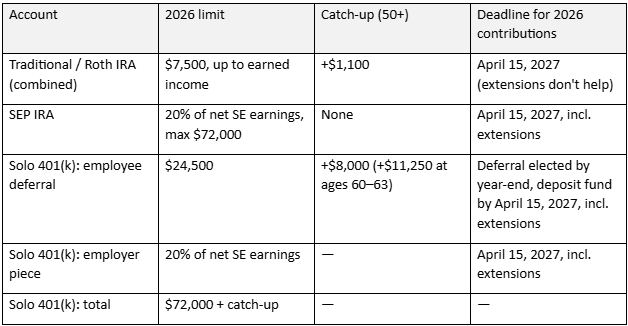
Net SE earnings = Schedule C profit minus half of self-employment tax.
Example: $100,000 Schedule C profit, under age 50
- Half of SE tax ≈ $7,065, so net SE earnings ≈ $92,935
- Employer contribution: 20% × $92,935 ≈ $18,587
- Employee deferral: $24,500
- Total ≈ $43,087, versus about $18,587 in a SEP IRA
If you later elect S-corporation status, the employer piece becomes 25% of your W-2 wages and deferrals come out of payroll.
Income limits and deductions
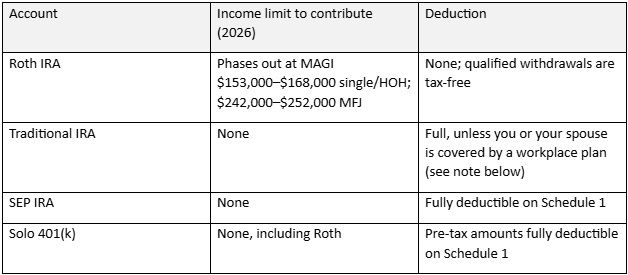
A note for married couples. If you file jointly and either spouse is covered by an employer retirement plan, the traditional IRA deduction can be reduced or eliminated, depending on your joint income.
Two more effects of traditional contributions: they lower income tax but not self-employment tax, and they reduce your qualified business income (QBI) deduction.
Setup time and costs
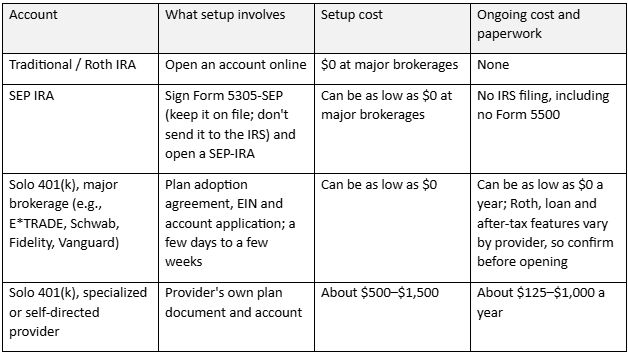
A Solo 401(k) must file Form 5500-EZ once combined assets in all of your one-participant plans exceed $250,000 at year-end, and again in the year the plan ends. The penalty for not filing can reach $250 a day, up to $150,000 a year, though the IRS offers a penalty relief program for late filers. SEP IRAs have no such filing.
A suggested way to decide
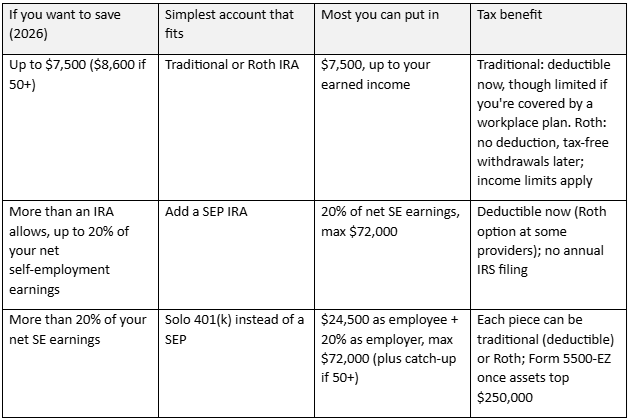
With the rules above in mind, here is one practical way to approach the choice. It's a starting point, not a rule, and your situation may call for something different. Begin with how much you want to put away for retirement each year. If you don't have a number yet, work with a financial advisor to set one based on your goals and cash flow.
Once you have a number, one approach is to start with the simplest account and move down the list only when you need more room:
This article is general information, not tax advice.
Sources
IRS
- IRS: One-participant 401(k) plans
- IRS: 401(k) and profit-sharing plan contribution limits (2026)
- IRS: Simplified Employee Pension plan (SEP)
- IRS: IRA contribution limits
- IRS: IRA deduction limits
- IRS Publication 560: Retirement Plans for Small Business
- IRS Publication 590-A: Contributions to IRAs
- IRS: Form 5500-EZ $250,000 filing threshold
Provider costs