
If you earn a modest income and save for retirement, the government will reward you. In 2026 that reward is the Saver's Credit. Starting in 2027, it becomes the Saver's Match.
The short version
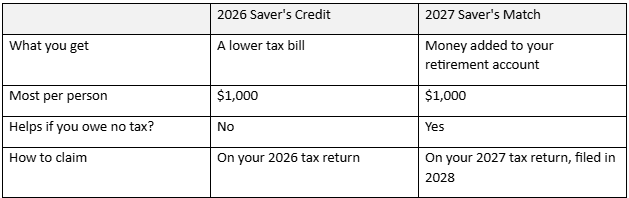
- 2026, Saver's Credit: lowers your tax bill by up to $1,000 per person, but only if you owe tax.
- 2027, Saver's Match: the government deposits up to $1,000 per person into your retirement account, even if you owe no tax.
Do you qualify?
You must be 18 or older, not a full-time student, and not claimed as someone's dependent. Your income must also be below these limits:
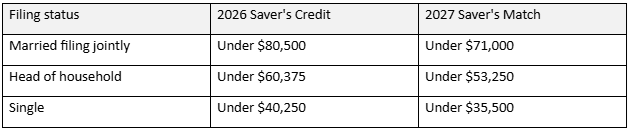
The lower your income, the bigger the benefit.
What counts
Money you put into a retirement account counts: a traditional or Roth IRA, or a workplace plan such as a 401(k). Your employer's contributions and rollovers don't count.
How it's calculated
Both programs use the same simple formula: your contribution (up to $2,000) × a percentage based on your income.
2026 Saver's Credit
Your percentage is 50%, 20% or 10%, depending on which income band you fall in.
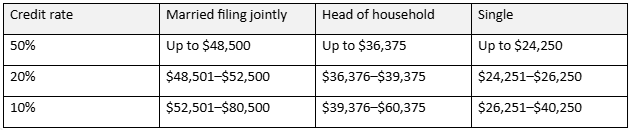
- Example 1: Single, At $24,000 of AGI and a contribution of $1,500: the filer stays in the 50% band (limit $24,250) and owes about $790 of tax, which allows the filer to claim the full $750 credit.
- Example 2: Married, income $55,000, each spouse puts $2,000 in a 401(k). 10% × $4,000 = $400 credit.
2027 Saver's Match
The government matches 50% of what you save, up to $2,000 per person. Once your income passes a starting point, that 50% shrinks gradually as income rises, until it reaches zero.
For married couples filing jointly, the full 50% applies up to $41,000 of combined income. Above that, the match drops by about 1 percentage point for every $600 of extra income: to roughly 35% at $50,000, 19% at $60,000 and 10% at $65,000, reaching 0% at $71,000. Heads of household phase out between $30,750 and $53,250, and single filers between $20,500 and $35,500.
For this purpose, "income" is your adjusted gross income plus any pre-tax 401(k) or deductible IRA contributions, so pre-tax saving doesn't lower it. Married couples are matched separately, each on their own contributions, but use their combined income.
Watch out for look-back rule
Taking money out of a retirement account shrinks the benefit, even if the withdrawal happened up to two years earlier.
Side by side
What to do now
- For claiming 2026 saver’s credit:
☐ Contribute for 2026: workplace plan by December 31, 2026, or an IRA by April 15, 2027.
☐ When preparing your 2026 tax return, tell your tax preparer about every retirement account contribution you made in 2026, and whether each was pre-tax or after-tax (Roth).
For claiming 2027 saver’s credit:
☐ For 2027, make sure you have a traditional IRA or workplace plan that accepts the match. Watch TrumpIRA.gov, launching January 1, 2027, for guidance on which IRA providers are eligible; further procedures are still to be published
☐ During 2027, assess whether you may qualify for the match, and talk to a tax professional or financial advisor.
This article is general information, not tax advice.