If you're living and working abroad, the headline IRA numbers the IRS publishes every year don't tell the whole story. The dollar limits are the easy part. The part that trips up overseas clients is figuring out what actually counts as compensation, and how the Foreign Earned Income Exclusion quietly reshapes your Modified Adjusted Gross Income (MAGI) for eligibility purposes — even after it's already zeroed out your regular income tax.
Here's what applies for the 2026 tax year, per IRS Notice 2025-67 and Publication 590-A.
The 2026 Contribution Limit
For 2026, the maximum you can contribute across all your Traditional and Roth IRAs combined is:
- $7,500 if you're under age 50
- $8,600 if you're 50 or older (a $1,100 catch-up, now itself adjusted annually for inflation under SECURE 2.0)
This is a combined cap — split it however you like between a Traditional and a Roth IRA, but the total can't exceed this amount. It's also capped by your taxable compensation for the year, whichever is lower.
This is the detail that matters most for expats: if you claim the Foreign Earned Income Exclusion (FEIE) on Form 2555 and it wipes out all of your wages, you have $0 of taxable compensation for IRA purposes — even though you may have earned well into six figures abroad. Only wages that are not excluded (income above the exclusion amount, or income you chose not to exclude) count toward your contribution room. A client earning $130,000 abroad and excluding all of it under FEIE technically cannot contribute to an IRA at all, unless some portion of their income remains taxable.
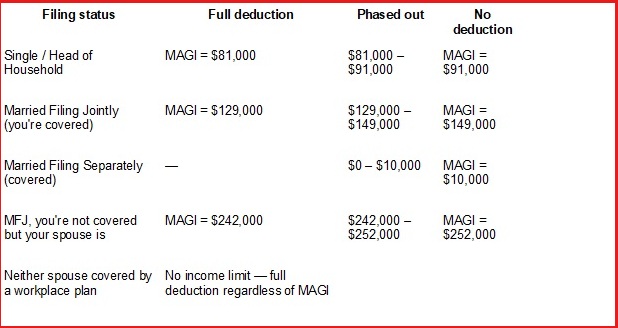
Traditional IRA Deduction Phase-Out (2026 MAGI)
If you or your spouse is covered by a retirement plan at work, your ability to deduct a Traditional IRA contribution phases out based on Modified Adjusted Gross Income:
Roth IRA Contribution Phase-Out (2026 MAGI)
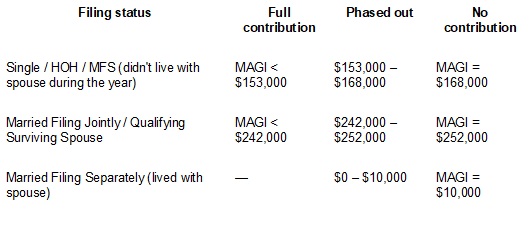
Roth eligibility works the same way, just measured against a different set of thresholds:
The Trap: MAGI Isn't What You Think It Is
Here's where I see the most confusion among overseas clients. Excluding foreign wages under the FEIE reduces your Adjusted Gross Income (AGI) — often down to $0. But for IRA eligibility purposes, that exclusion gets added back when the IRS calculates your Modified AGI.
In other words: your AGI and your MAGI can be two very different numbers. A client who excludes $130,000 of foreign wages might show $0 of AGI on their return, but their MAGI for IRA purposes still reflects that $130,000 — and possibly pushes them into or past a phase-out range they assumed didn't apply to them.
Publication 590-A walks through this calculation step by step in Worksheet 1-1, Figuring Your Modified AGI, which starts with AGI computed before any IRA deduction and adds back:
- The Foreign Earned Income Exclusion and/or Foreign Housing Exclusion or Deduction (Form 2555)
- Student loan interest deduction
- Excluded U.S. savings bond interest used for education (Form 8815)
- Excluded employer-provided adoption benefits (Form 8839)
A parallel worksheet applies for Roth IRA eligibility.
The Bottom Line for Overseas Clients
Two questions decide whether an IRA contribution makes sense for a client living abroad:
- Do you have any non-excluded taxable compensation this year? If the FEIE covers all of your wages, you likely have no contribution room at all — regardless of how much you earned.
- If you do have contribution room, what's your MAGI once the exclusion is added back? Don't assume a low AGI means you're safely under the phase-out thresholds.
For clients with mixed income — some wages above the FEIE cap, self-employment income, or investment income not eligible for exclusion — a careful MAGI calculation before year-end can mean the difference between a deductible contribution and a wasted one.
Source: IRS Notice 2025-67 (2026 cost-of-living adjustments), IRS Publication 590-A, Contributions to Individual Retirement Arrangements (IRAs), and the IRS IRA Deduction Limits reference page.